Here is a more detailed guide on cover letters for scientific journal submissions, with additional examples and frequently asked questions.
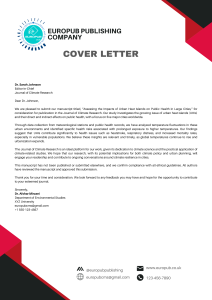
Expanded Explanation of Each Section of a Cover Letter
1. Addressing the Editor:
• Begin with a formal salutation to the editor-in-chief or handling editor of the journal.
• Research the correct editor’s name and title; this personal touch demonstrates attention to detail.
Example:
Dr. Jane Smith
Editor-in-Chief
International Journal of Environmental Science
2. Manuscript Title and Submission Details:
• State the title of your manuscript and specify the type of submission (e.g., original research, review article).
Example:
We are submitting our original research article titled, “Effects of Climate Change on Coastal Biodiversity,” for your consideration for publication in the International Journal of Environmental Science.
3. Brief Summary of the Research and Objectives:
• Provide a concise summary of the paper’s objectives and significance, emphasizing key findings.
• Avoid detailed data; instead, focus on the broader relevance and scope.
Example:
Our research explores how rising sea levels and increased temperatures are impacting coastal biodiversity. We conducted an in-depth analysis of [mention specific methods or approach briefly], revealing that [state one or two major findings].
4. Importance and Novelty of the Work:
• Explain how your study addresses gaps in the current research, advances understanding, or has practical applications.
• Mention how the findings contribute to the field and relate to contemporary issues or challenges.
Example:
Our study is unique in its integrative approach, combining fieldwork data with predictive modeling. By uncovering patterns in [mention specific findings], our work offers new insights into the management of endangered ecosystems, particularly in vulnerable coastal regions.
5. Why This Journal:
• Demonstrate familiarity with the journal by linking the study’s aims and audience to the journal’s scope.
• Explain how the research is likely to interest the journal’s readership.
Example:
We believe that the International Journal of Environmental Science, with its focus on pressing ecological issues, is the perfect platform for our findings. Given the relevance of our study to environmental conservation, we feel that your readership will benefit from our insights into climate change impacts.
6. Declaration of Ethical Standards:
• Reiterate that the manuscript has not been published or submitted elsewhere and complies with ethical guidelines, including transparency and permissions for figures or data used.
Example:
We confirm that this manuscript has not been previously published, nor is it under consideration by any other journal. All necessary permissions for data and figures have been obtained, and ethical guidelines have been adhered to.
7. Author Contributions (Optional):
• Summarize the roles of the authors if required by the journal. This can help clarify the distribution of responsibilities and contributions.
8. Contact Information and Conclusion:
• Provide contact details, including an email address and phone number, for the corresponding author, ensuring the editor can reach out for further inquiries.
• Close respectfully with an expression of appreciation.
Example:
Thank you for your time and consideration. We look forward to the possibility of sharing our work with your readership.
Sincerely,
Dr. A. Mirzaei
Department of Environmental Science
University of XYZ
europubcms@gmail.com
+1 555-123-4567
Additional Sample Cover Letter
Dr. Michael Johnson
Editor-in-Chief
Journal of Public Health and Policy
Dear Dr. Johnson,
We are pleased to submit our manuscript titled, “The Socioeconomic Impact of Health Disparities in Urban Populations,” for publication in the Journal of Public Health and Policy. This study investigates the links between socioeconomic status and health outcomes across different urban communities, emphasizing actionable policy implications for reducing health inequities.
Our work addresses a critical gap in understanding how economic factors influence public health, especially in diverse metropolitan areas. The research is grounded in robust statistical analysis and offers recommendations that could shape policy interventions aimed at improving health access.
Given the journal’s dedication to impactful public health research, we believe our findings will resonate with both policymakers and academics. We confirm that this manuscript is original, has not been submitted elsewhere, and adheres to ethical guidelines.
Thank you for your consideration. We look forward to your feedback.
Sincerely,
Dr. Emily Carter
Department of Public Health
XYZ University
emilycarter@xyz.edu
+1 555-987-6543
Useful Links and Resources for Writing Cover Letters
• Elsevier’s Guide to Cover Letters: Comprehensive guidelines on how to structure an effective cover letter.
• Springer’s Sample Cover Letter: Provides specific examples and tips for authors.
• Wiley’s Cover Letter Tips: Useful insights on what to include and how to format your letter.
Frequently Asked Questions About Cover Letters
• What is the primary purpose of a cover letter in scientific publishing?
• A cover letter introduces your manuscript to the journal editor, provides context on the research’s value, and explains why the article is suited to that journal.
• How long should a cover letter be?
• Typically, a cover letter should be concise and not exceed one page. Aim for 300-500 words.
• What tone should a cover letter have?
• Maintain a professional, polite, and positive tone, focusing on facts rather than overly promotional language.
• Do all journals require a cover letter?
• While not mandatory for all journals, most reputable journals expect a cover letter with submissions.
• Can I use the same cover letter for multiple journals?
• It is best to tailor each cover letter specifically to the journal, highlighting why your manuscript is a good fit for its audience and scope.
• Should the cover letter include details about ethical standards?
• Yes, mention any ethical approvals, and confirm the manuscript’s originality and compliance with submission policies.
• Is it important to address the editor by name?
• Whenever possible, address the editor-in-chief by name, as this demonstrates professionalism and respect.
A carefully crafted cover letter can set a positive tone and highlight the manuscript’s value to the editor, significantly impacting the submission process.