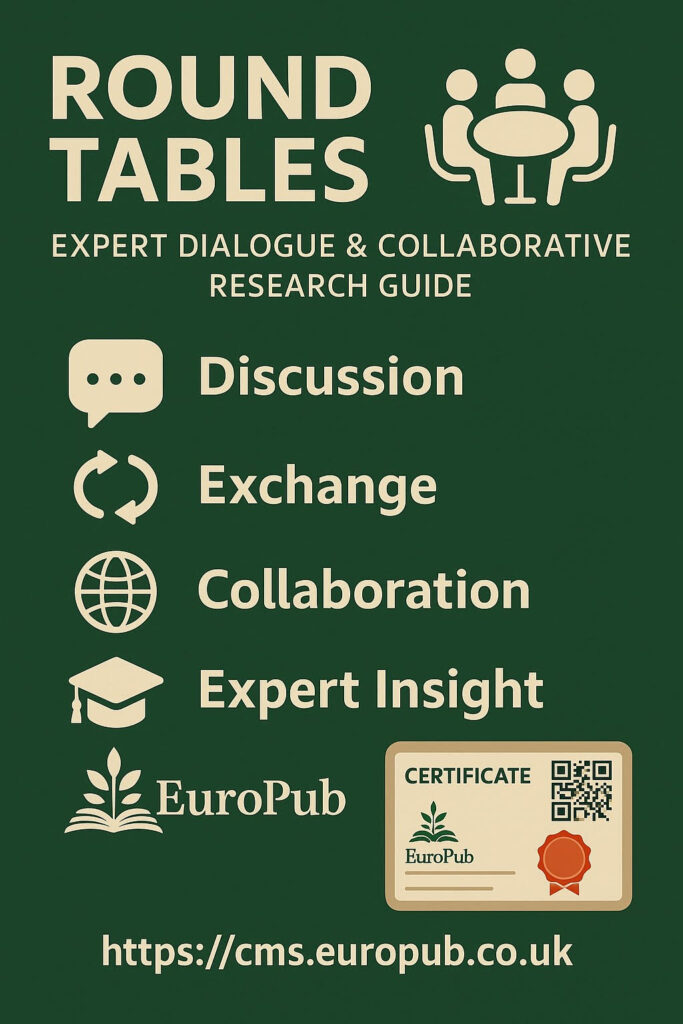
A Round Table is a structured academic discussion format where a small group of experts, researchers, or stakeholders engage in an open, democratic conversation on a specific topic.
Unlike traditional presentations, everyone participates equally, making round tables ideal for debate, policy analysis, problem-solving, and collaborative decision-making.
 Purpose of a Round Table
| Objective | Explanation |
|---|---|
 Open Discussion Open Discussion | Encourages diverse viewpoints without hierarchy |
 Collective Insight Collective Insight | Combines expertise to explore solutions |
 Focused Debate Focused Debate | Addresses a specific issue in depth |
 Collaborative Learning Collaborative Learning | Builds professional and intellectual connections |
 Policy or Research Development Policy or Research Development | Shapes strategies, frameworks, or future studies |
 Types of Academic Round Tables
| Type | Description |
|---|---|
| Research Round Table | Experts discuss findings, gaps, and future directions |
| Policy Round Table | Focused on social, scientific, or governmental policy issues |
| Interdisciplinary Round Table | Combines perspectives from multiple fields |
| Student Round Table | Encourages academic dialogue and peer learning |
| Virtual Round Table | Conducted online via Zoom, MS Teams, or similar tools |
Structure of a Round Table
 Opening Remarks
Brief introduction by moderator (topic overview, goals, and rules).
 Participant Introductions
Each expert introduces their background and perspective.
 Discussion Blocks
The moderator leads topic segments, ensuring balanced participation.
 Interactive Exchange
Participants ask questions, challenge arguments, propose insights.
 Conclusion & Recommendations
Key messages, outcomes, and future directions are summarized.
 Certificates
All contributors receive participation or expert contribution certificates.
 Benefits of Academic Round Tables
| Benefit | Explanation |
|---|---|
 Knowledge Sharing Knowledge Sharing | High-level intellectual exchange |
 Networking Networking | Builds stronger academic and professional ties |
 Innovation Innovation | Generates new ideas, theories, and collaborations |
 Professional Credibility Professional Credibility | Positions participants as experts in the field |
 Recognition Recognition | Formal certificates strengthen CV and research profile |
 Best Practices for Effective Round Tables
| Tip | Why It Works |
|---|---|
 Prepare key points beforehand Prepare key points beforehand | Ensures meaningful contributions |
| Respect speaking time | Allows balanced participation |
| Listen actively | Encourages deeper insights and collaboration |
| Ask probing questions | Improves the quality of discussion |
| Summarize ideas | Enhances clarity and productivity |
 Common Mistakes to Avoid
 Dominating the conversation
- Going off-topic or unfocused discussion
- Lack of preparation
- Ignoring other viewpoints
- Poor moderation or time management
 Ethics & Professional Conduct
- Encourage respectful dialogue.
- Acknowledge contributions properly.
- Avoid sharing confidential insights without permission.
- Follow academic integrity and COPE communication ethics.
Useful Resources
| Resource | Link |
|---|---|
| Online Round Table Tools | https://zoom.us |
| Google Meet | https://meet.google.com |
| Microsoft Teams | https://www.microsoft.com/microsoft-teams |
| OECD Round Table Examples | https://www.oecd.org |
| Europub Certificate System | https://cms.europub.co.uk |
| Europub Database | https://europub.co.uk |
| Europub Scientific News | https://news.europub.co.uk |
FAQs — Round Tables
 1. How is a round table different from a panel discussion?
A panel is where invited speakers present; a round table involves equal, open participation from all members.
2. Who can participate?
Researchers, students, faculty, policymakers, and industry experts depending on the topic.
3. Do round tables issue certificates?
Yes — participation or expert contribution certificates are commonly awarded.
4. Can round tables be held online?
Absolutely. Virtual round tables are now standard and widely accepted.
5. What topics are ideal for round tables?
Debates, emerging challenges, policy issues, ethics discussions, interdisciplinary research, and strategic planning.
6. How does Europub support round tables?
Europub provides:
- Verified round table participation certificates
- DOI assignment for round-table reports
- Indexing of academic event records
 Europub Certification Reminder
Enhance your academic profile with Europub-certified credentials:
- Round Table Participation Certificate
- Expert Contribution Certificate
- Research Discussion Verification Badge
Apply here: