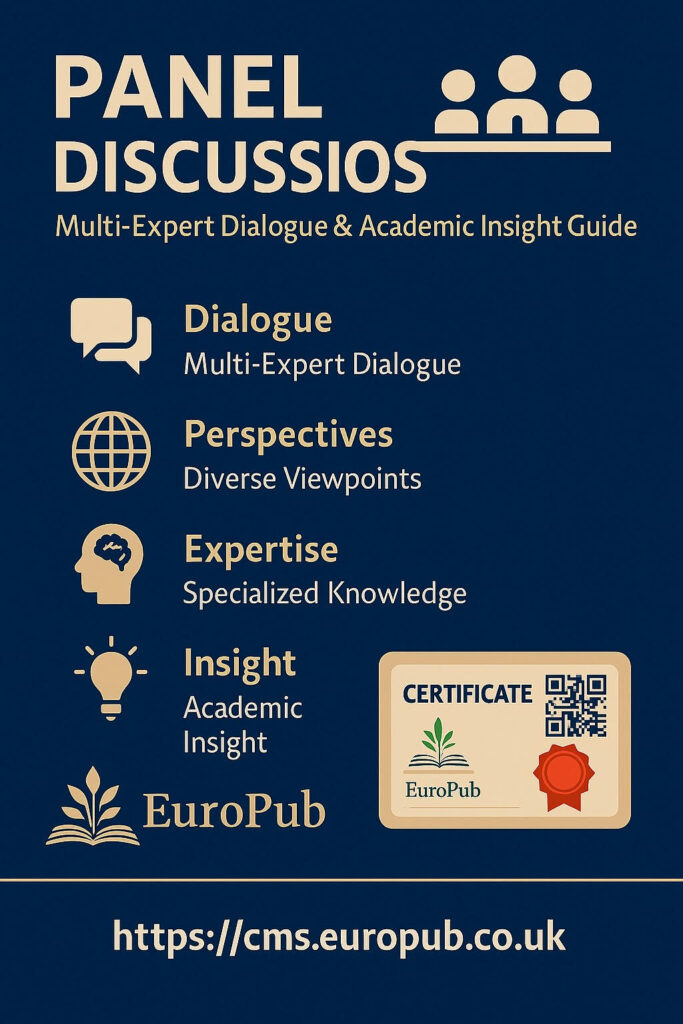
A Panel Discussion is an academic event where several invited experts share insights, debate ideas, and discuss a topic from multiple perspectives in front of an audience.
Panels are moderated, structured, and expert-driven, making them ideal for complex topics that require diverse viewpoints.
 Purpose of a Panel Discussion
| Objective | Explanation |
|---|---|
 Multi-Perspective Insight Multi-Perspective Insight | Combines expertise from different specialists |
 Public Dialogue Public Dialogue | Encourages audience engagement through Q&A |
 Knowledge Dissemination Knowledge Dissemination | Shares current research trends and debates |
 Networking Networking | Connects panelists and attendees professionally |
 Academic Influence Academic Influence | Shapes opinions, research priorities, and policies |
 Types of Academic Panel Discussions
| Type | Description |
|---|---|
| Expert Panel | Leading researchers discuss advanced topics |
| Industry–Academic Panel | Collaboration between professionals and scholars |
| Policy Panel | Focus on policy impact, ethics, or regulations |
| Student Panel | Students present ideas with mentor guidance |
| Hybrid / Online Panels | Conducted via Zoom or conferences for global audiences |
Structure of a Panel Discussion
 Moderator Introduction
Introduces topic, panelists, and discussion goals.
 Panelist Opening Statements
Each panelist gives a short overview of their viewpoint.
 Guided Discussion
Moderator asks questions; panelists respond and debate.
 Audience Q&A
Participants ask questions; panelists provide insights.
 Closing Statements
Panelists summarize their key messages.
 Certificates & Acknowledgments
Panelists and participants receive official certificates.
 Benefits of Panel Discussions
| Benefit | Explanation |
|---|---|
 Broad Knowledge Broad Knowledge | Access to multiple expert perspectives |
 Critical Thinking Critical Thinking | Encourages examination of different viewpoints |
 Collaboration Collaboration | Builds academic and professional relationships |
 Presentation Skills Presentation Skills | Enhances public speaking and debate abilities |
 Recognition Recognition | Certificates add value to academic CVs |
Best Practices for Panelists
| Tip | Why It Works |
|---|---|
 Prepare key talking points Prepare key talking points | Ensures clarity and relevance |
| Respect other speakers | Supports balanced conversation |
| Avoid long monologues | Keeps discussion dynamic |
| Use evidence & data | Strengthens arguments |
| Engage the audience | Builds connection and impact |
 Common Mistakes to Avoid
 Dominating the discussion
- Going off-topic or avoiding the theme
- Interrupting other panelists
- Giving overly technical answers with no examples
- Not preparing for moderator questions
 Ethics & Professional Conduct
- Maintain respect for diverse opinions.
- Acknowledge sources, research, and collaborators.
- Avoid promoting personal agendas or bias.
- Follow institutional and COPE ethical guidelines.
Useful Resources
| Resource | Link |
|---|---|
| Zoom Events | https://zoom.us |
| Google Meet | https://meet.google.com |
| Microsoft Teams | https://www.microsoft.com/microsoft-teams |
| Elsevier Events | https://www.elsevier.com/events |
| Springer Events | https://www.springer.com/gp/conference |
| Europub Certificate System | https://cms.europub.co.uk |
| Europub Database | https://europub.co.uk |
| Europub Scientific News | https://news.europub.co.uk |
FAQs — Panel Discussions
 1. How is a panel discussion different from a round table?
A round table involves equal participation from all attendees; a panel discussion features invited experts speaking to an audience.
2. Who can be a panelist?
Researchers, professors, professionals, policymakers, or subject-matter experts.
3. Do panelists receive certificates?
Yes — Europub provides Panelist Contribution Certificates and Participation Certificates.
4. Are panel discussions recognized as academic activities?
Absolutely. They count toward teaching, research communication, and academic service.
5. Can panel discussions be online?
Yes. Online panels are widely accepted and common internationally.
6. What topics are suitable?
Ethics, AI, medical science, climate change, publishing, education, policy, and interdisciplinary issues.
 Europub Certification Reminder
Enhance your academic portfolio with Europub-certified achievements:
- Panelist Certificate
- Panel Participation Certificate
- Expert Contribution Badge
Apply here: