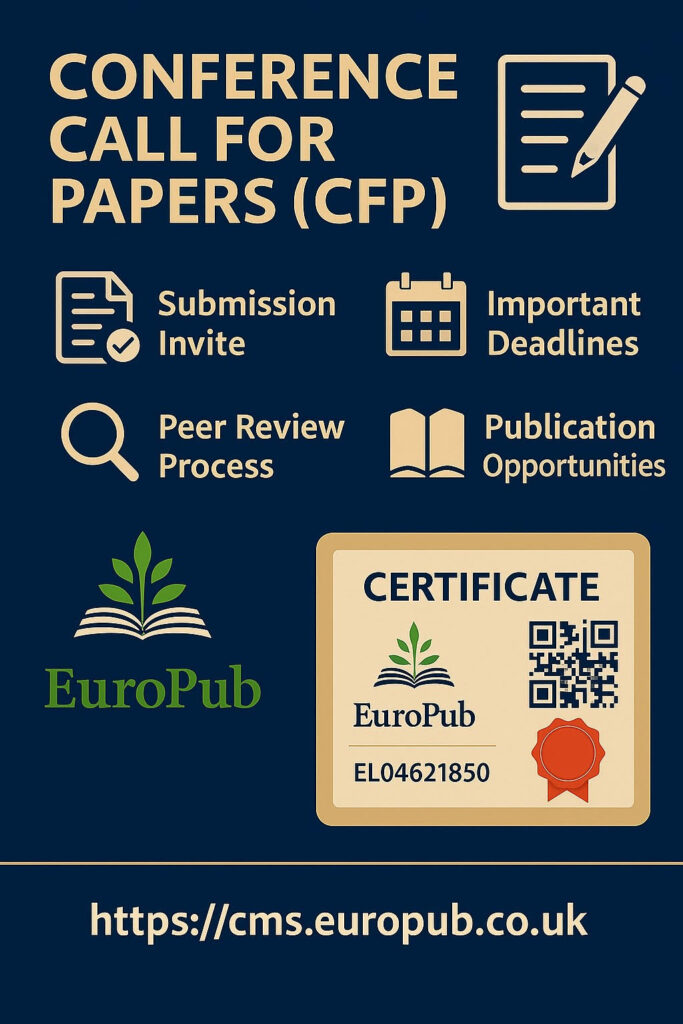
A Call for Papers (CFP) is an official announcement inviting researchers to submit their work for presentation at an academic conference.
It outlines the conference theme, submission guidelines, deadlines, review process, and publication opportunities.
The CFP is the first and most important communication between conference organizers and researchers worldwide.
 Purpose of a Call for Papers
| Objective | Explanation |
|---|---|
 Invite Submissions Invite Submissions | Attracts research papers, posters, and presentations |
 Define Themes Define Themes | Explains the topics or tracks covered by the conference |
 Ensure Quality Ensure Quality | Describes peer-review or editorial processes |
 Communicate Deadlines Communicate Deadlines | Provides clear submission dates and timelines |
 Publication Pathway Publication Pathway | Explains journals, proceedings, or indexing options |
 Key Components of a CFP
Every professional Call for Papers should include:
 Conference Details
- Title
- Date & location (or online platform)
- Host institution / organizers
 Conference Themes & Tracks
Clear list of topics such as:
- AI & Data Science
- Environmental Engineering
- Agriculture & Life Sciences
- Business & Economics
- Medical & Health Research(and more depending on the event)
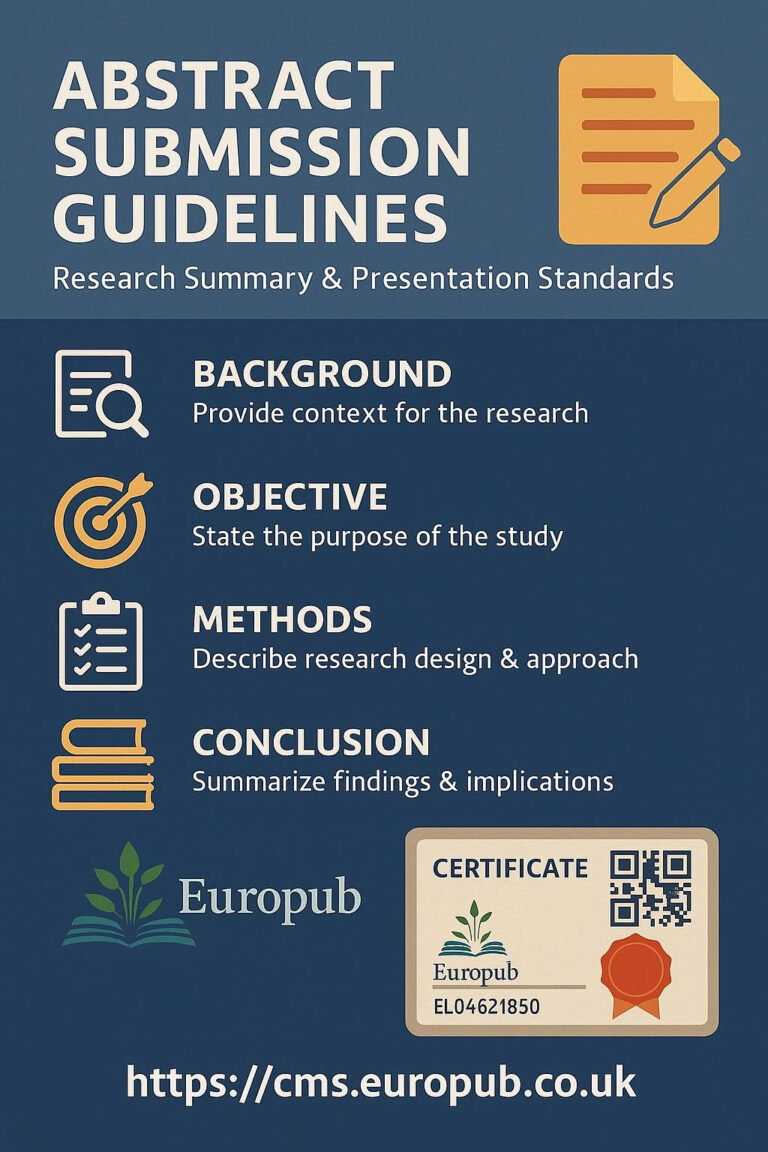
 Submission Guidelines
- Abstract length (e.g., 200–300 words)
- Full paper length (optional)
- Required formatting
- Submission portal or email
 Important Dates
- Abstract submission deadline
- Acceptance notification date
- Full paper deadline
- Registration deadline
- Conference dates
 Review Process
- Single-blind / double-blind peer review
- Editorial screening
- Scientific committee evaluation
 Publication Opportunities
May include:
- Conference proceedings
- Special issues in indexed journals (Scopus / WoS)
- Europub-indexed journals
- Abstract book with ISBN
- DOI assignment for accepted papers
 Certificates
- Presentation certificate
- Participation certificate
- Best paper / best presenter awards
 Contact Information
- Website
- Social media links
- Organizing committee contacts
 Why CFPs Matter for Researchers
| Benefit | Explanation |
|---|---|
 Global Visibility Global Visibility | Presents your research to international audiences |
| Academic Recognition | Enhances your CV and scholarly profile |
 Networking Networking | Connects you with experts, reviewers, and editors |
 Publication Chance Publication Chance | Selected papers may be published in indexed journals |
 Awards Awards | Opportunities for best paper or presentation prizes |
 Tips for Responding to a CFP Successfully
| Tip | Why It Works |
|---|---|
 Follow formatting instructions Follow formatting instructions | Ensures your work is reviewed fairly |
| Submit early | Avoids email or portal errors close to deadlines |
| Align your topic with conference themes | Increases acceptance chance |
| Write a clear abstract | Key criteria for selection |
| Check publication details | Ensure journals or proceedings meet your goals |
 Common Mistakes to Avoid
 Submitting unrelated or off-topic work
- Ignoring deadlines
- Not reading author guidelines carefully
- Poor abstract structure
- No keywords or unclear title
 Ethics in CFP Participation
- Submit only original research
- Avoid duplicate submission to multiple conferences
- Cite prior work correctly
- Respect peer-review confidentiality
- Follow COPE ethical standards
Useful Resources
| Resource | Link |
|---|---|
| Conference Alerts | https://conferencealerts.com |
| Elsevier Events | https://www.elsevier.com/events |
| Springer Conferences | https://www.springer.com/gp/conference |
| IEEE CFPs | https://conferences.ieee.org |
| Europub Certificate System | https://cms.europub.co.uk |
| Europub Database | https://europub.co.uk |
| Europub Scientific News | https://news.europub.co.uk |
FAQs — Conference Call for Papers (CFP)
 1. What is the purpose of a CFP?
To invite researchers to submit work that fits the conference theme.
2. Do all conferences publish accepted papers?
No. Some publish only abstracts; others publish full papers in proceedings or indexed journals.
3. Can students submit to CFPs?
Yes — undergraduate, postgraduate, and PhD students are encouraged to submit.
4. What is the acceptance rate?
Depends on the conference quality, theme, and number of submissions.
5. Is it necessary to submit a full paper?
Many CFPs accept abstract-only submissions, while others require full papers.
6. How does Europub support CFPs?
Europub provides:
- CFP promotion
- DOI assignment
- Certificate generation
- Indexing of conference proceedings
 Europub Certification Reminder
Strengthen your academic profile by earning official Europub certificates:
- CFP Submission Certificate
- Accepted Abstract Certificate
- Conference Presentation Certificate
Apply at: