An abstract is a concise summary of a research paper, conference presentation, or poster.
It is often the first and most important part reviewers evaluate when deciding whether your work will be accepted for a conference, symposium, seminar, or journal.
A strong abstract increases your chances of acceptance and enhances the visibility of your research.
 Purpose of an Abstract
| Objective | Explanation |
|---|---|
 Summarize Research Summarize Research | Provides a quick overview of the study |
 Demonstrate Relevance Demonstrate Relevance | Shows why the topic matters |
 Help Reviewers Decide Help Reviewers Decide | Critical for acceptance decisions |
 Inform Audience Inform Audience | Allows participants to understand the focus |
 Increase Visibility Increase Visibility | Helps indexing and future citations |
 Components of a High-Quality Abstract
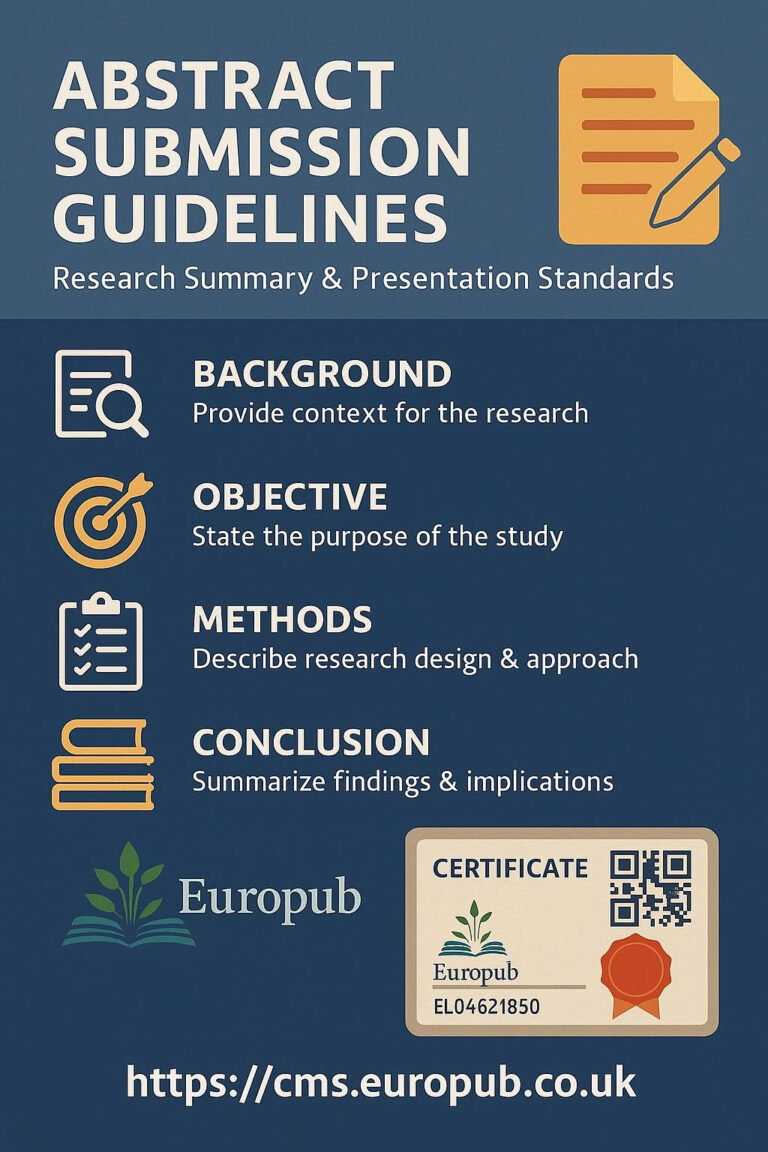
A good abstract usually contains 5 core elements:
 Background / Context
Brief introduction to the research problem or topic.
 Objective / Purpose
What the study aims to achieve.
 Methods
Overview of methodology, tools, or approach used.
 Results / Findings
Key outcomes or insights (even preliminary results).
 Conclusion / Implications
What the results mean, and how they contribute to the field.
 Formal Structure Recommended in CFPs
Most conferences request:
- Word Count: 150–300 words
- Keywords: 3–6 keywords
- Format: Times New Roman or similar, size 12
- Spacing: Single-spaced
- Language: Clear academic English
- File Format: Word document (.doc/.docx) or PDF
- Submission Method: Via conference portal or official email
 Tips for Writing an Effective Abstract
| Tip | Why It Works |
|---|---|
 Be concise Be concise | Reviewers appreciate clarity and brevity |
| Use strong keywords | Improves indexing and discoverability |
| Avoid jargon | Ensures comprehension by a wider audience |
| Focus on results | Reviewers look for contributions, not introductions |
| Follow the CFP’s format exactly | Increases acceptance probability |
 Mistakes to Avoid
- Writing too broadly or vaguely
- Including citations (not typical in abstracts)
- Adding tables, images, or long lists
- Leaving out results or conclusions
- Exceeding word limits
- Grammatical or spelling errors
 Sample Abstract Format
Title:
Short, specific, and relevant
Author(s):
Name, institution, email, ORCID (optional)
Abstract:
This study investigates the impact of digital certification systems on academic visibility across international research databases. Using a mixed-methods design, we analyzed 4,500 researcher profiles and conducted interviews with 28 academic editors. Findings indicate significant improvements in citation rates among users of verified certification platforms. These results highlight the importance of digital authentication tools for strengthening global research integrity and recognition.
Keywords:
Certification, Research Visibility, Academic Impact, Digital Identity
 Ethical Guidelines
- Submit only original work
- Avoid plagiarism or self-plagiarism
- Do not include confidential or unpublished data without permission
- Follow COPE and institutional ethics
 Useful Resources
| Resource | Link |
|---|---|
| Elsevier Author Guidelines | https://www.elsevier.com/authors |
| Springer Author Resources | https://www.springer.com/gp/authors-editors |
| IEEE Abstract Guidelines | https://www.ieee.org |
| Europub Certificate System | https://cms.europub.co.uk |
| Europub Database | https://europub.co.uk |
| Europub Scientific News | https://news.europub.co.uk |
 FAQs — Abstract Submission
 1. What is the ideal abstract length?
Between 150–300 words, unless the CFP specifies otherwise.
2. Can I submit the same abstract to multiple conferences?
Only if allowed by the organizers — always check guidelines.
3. Should I include references?
No. Abstracts typically do not contain citations or references.
4. What happens after submission?
Your abstract undergoes peer review or editorial evaluation.
5. What if my abstract is rejected?
You may revise and submit to another conference or journal.
6. Does Europub verify abstract submissions?
Yes — Europub provides:
- Abstract Submission Certificates
- Accepted Abstract Certificates
- DOI assignment for conference materials
 Europub Certification Reminder
Strengthen your academic profile with Europub-certified documents:
- Abstract Submission Certificate
- Abstract Acceptance Certificate
- Conference Presentation Certificate
Apply here: